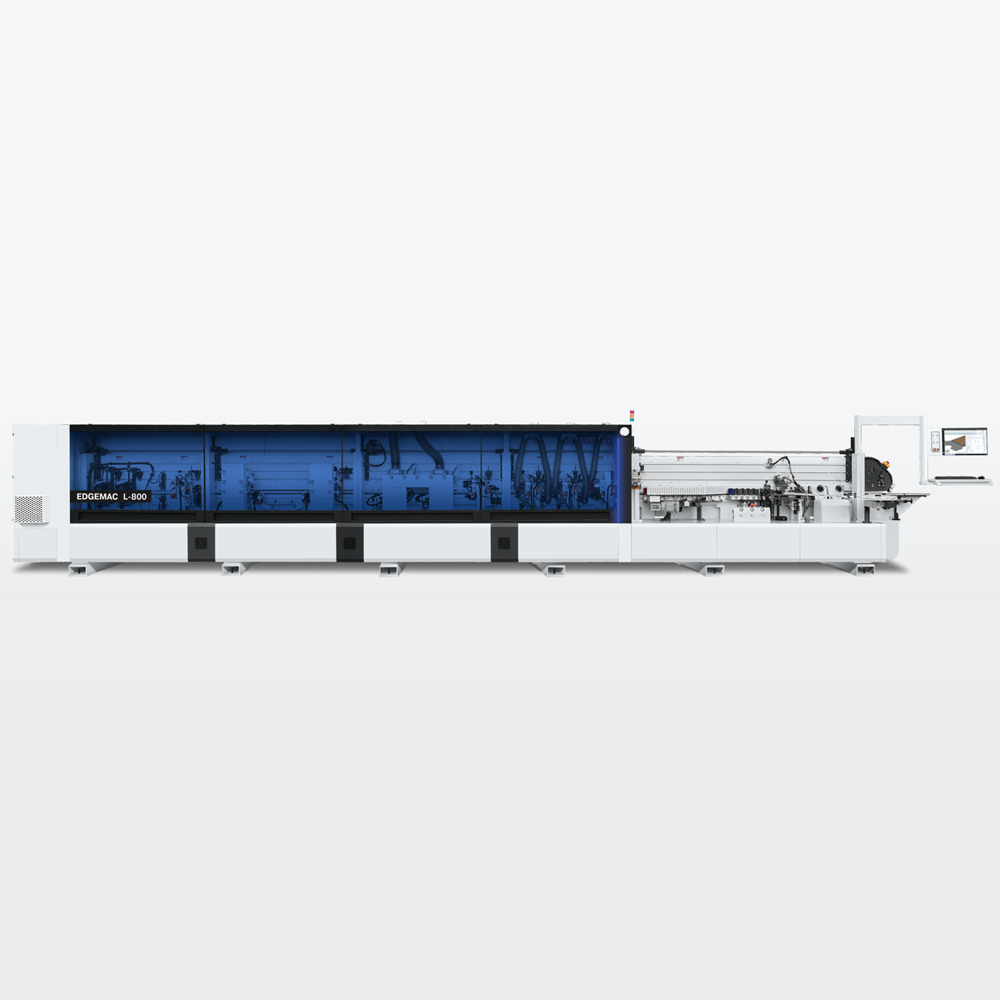
1. Introduction to Automatic Edge Banding Machines
An Automatic Edge Banding Machine is an industrial processing system designed to apply protective and decorative edge materials to the exposed edges of panels. It is widely used in furniture manufacturing, kitchen cabinet production, aluminum furniture processing, and composite panel fabrication.
Compared with manual and semi-automatic edge banding equipment, an automatic edge bander integrates multiple processing operations into a continuous production workflow. These operations typically include automatic feeding, pre-milling, adhesive application, edge material feeding, pressing, end trimming, rough trimming, fine trimming, scraping, and polishing.
The main purpose of automatic edge banding is to improve production efficiency, maintain consistent edge quality, reduce labor requirements, and protect panel edges against mechanical damage and environmental exposure.
With the increasing use of aluminum honeycomb panels, FRP sandwich panels, PVC foam boards, and other lightweight composite materials, industrial edge banding technology is also evolving toward specialized automated processing solutions.
2. How Does an Automatic Edge Banding Machine Work?
An automatic edge banding machine operates through a coordinated sequence of mechanical, electrical, and pneumatic systems. Each processing unit performs a specific operation to achieve a finished panel edge.
Step 1: Automatic Panel Feeding
The panel is transferred into the machine through an automatic feeding conveyor. Guide rails, positioning rollers, and pressure devices help maintain stable panel movement.
Consistent feeding is important because panel misalignment can affect adhesive distribution, trimming accuracy, and final edge quality.
Step 2: Pre-Milling and Edge Preparation
The pre-milling unit removes minor irregularities, saw marks, and surface defects left by previous cutting operations.
A clean and uniform edge improves the contact condition between the panel and edge banding material, contributing to more consistent bonding.
Step 3: Adhesive Application
The adhesive application system distributes bonding material onto the panel edge or edge banding material.
Common adhesive options include:
- EVA hot melt adhesive
- PUR reactive polyurethane adhesive
- Specialized industrial bonding adhesives
Adhesive selection depends on panel material, operating temperature, moisture exposure, and required bonding performance.
Step 4: Edge Material Feeding
The edge feeding system supplies the edge banding material from a roll or strip. A controlled feeding mechanism aligns the material with the panel edge.
Common materials include PVC, ABS, acrylic, veneer, and solid wood strips. Specialized machines may also process aluminum edge strips and other industrial edge components.
Step 5: Pressing and Bonding
Pressure rollers press the edge material against the panel edge. Proper pressure and positioning help ensure sufficient adhesive contact and uniform bonding.
The pressing system must be adjusted according to edge material thickness, panel dimensions, and adhesive characteristics.
Step 6: End Trimming
The end trimming unit removes excess edge material extending beyond the front and rear ends of the panel.
This operation creates clean edge transitions and prepares the panel for subsequent finishing.
Step 7: Rough and Fine Trimming
Rough trimming removes excess material from the upper and lower edges. Fine trimming then produces the required edge profile and dimensional accuracy.
Step 8: Scraping and Polishing
The scraping unit removes minor trimming marks and adhesive residue. The polishing unit uses rotating brushes to improve the final surface appearance.
The finished panel is then transferred to the unloading or inspection station.
3. Main Components of an Automatic Edge Banding Machine
The overall performance of an automatic edge bander depends on the mechanical structure, drive system, control system, and processing units.
| Main Component | Function | Importance |
|---|---|---|
| Feeding Conveyor | Transfers panels through the machine | Stable material transportation |
| Pre-Milling Unit | Prepares panel edges | Improves edge uniformity |
| Glue Application System | Applies adhesive | Determines bonding consistency |
| Edge Feeding System | Supplies edge banding material | Maintains material alignment |
| Pressure Rollers | Press edge material onto panels | Supports reliable bonding |
| End Trimming Unit | Removes excess material at panel ends | Produces clean panel ends |
| Rough Trimming Unit | Removes excess edge material | Establishes basic edge geometry |
| Fine Trimming Unit | Finishes upper and lower edges | Improves dimensional accuracy |
| Scraping Unit | Removes minor machining marks | Improves edge appearance |
| Polishing Unit | Finishes the edge surface | Produces a smooth appearance |
| PLC Control System | Coordinates machine operations | Supports stable automated production |
Not all automatic edge banding machines contain every unit. Industrial equipment can be configured according to panel materials, edge geometry, and production requirements.
4. Important Technical Parameters of Automatic Edge Banding Machines
Technical specifications are important when comparing different automatic edge banding machines. Buyers should evaluate not only nominal production speed but also the machine’s actual processing capability.
| Technical Parameter | Typical Considerations |
|---|---|
| Panel Thickness | Common woodworking models support approximately 10–60 mm |
| Edge Banding Thickness | Often approximately 0.4–3 mm for standard models |
| Feeding Speed | Common configurations range from approximately 8–25 m/min |
| Working Pressure | Depends on pneumatic and pressing system design |
| Heating System | Controlled according to adhesive requirements |
| Adhesive Type | EVA, PUR or specialized industrial adhesives |
| Control System | PLC, touchscreen or integrated CNC control |
| Processing Units | Pre-milling, gluing, trimming, scraping and polishing |
| Power Supply | Depends on machine configuration and regional standards |
| Machine Customization | Based on panel dimensions and production requirements |
These values are indicative ranges for conventional industrial woodworking equipment, not universal specifications. Aluminum honeycomb panels and composite sandwich panels may require different machine structures and processing parameters.
5. Different Adhesive Systems Used in Automatic Edge Banding
Adhesive technology directly affects bonding strength, processing stability, and finished product performance.
EVA Hot Melt Adhesive
EVA is commonly used in furniture manufacturing because of its relatively low equipment cost, straightforward processing, and compatibility with conventional edge banding materials.
It is suitable for MDF, particleboard, plywood, and other wood-based panels.
PUR Reactive Adhesive
PUR adhesive reacts with moisture and forms a cross-linked bonding structure after curing.
Its advantages include improved moisture resistance, heat resistance, and bonding durability compared with many conventional EVA systems.
PUR edge banding is commonly used for kitchen cabinets, bathroom furniture, and applications requiring enhanced environmental resistance.
Specialized Industrial Adhesives
For aluminum composite panels, FRP sandwich panels, and aluminum honeycomb panels, adhesive selection must consider the surface chemistry of the face sheets and the properties of the core material.
The adhesive must be compatible with aluminum, fiberglass, foam cores, or other substrates involved in the bonding process.
6. Industrial Applications of Automatic Edge Banding Machines
Furniture Manufacturing
Automatic edge banders are widely used in the production of kitchen cabinets, wardrobes, bathroom cabinets, office furniture, and decorative furniture panels.
They provide consistent edge finishing and support high-volume panel processing.
Aluminum Furniture Manufacturing
Aluminum furniture manufacturers use specialized edge processing equipment for aluminum cabinet panels, aluminum doors, and aluminum honeycomb furniture boards.
Depending on product design, processing methods may include aluminum strip bonding, mechanical pressing, edge folding, and profile installation.
Aluminum Honeycomb Panel Manufacturing
Aluminum honeycomb panels consist of two face sheets bonded to an aluminum honeycomb core. Their edges require appropriate treatment to protect the internal core and achieve a finished appearance.
A dedicated Aluminum Honeycomb Panel Edge Banding Machine may integrate:
- Automatic panel positioning
- Edge trimming and milling
- Aluminum strip feeding
- Adhesive application
- Edge pressing
- Edge folding or sealing
The actual configuration depends on panel construction and edge design. Conventional woodworking equipment should not be assumed to process aluminum honeycomb panels without modification.
Composite Sandwich Panel Manufacturing
FRP sandwich panels, PVC foam core panels, PET foam core panels, and XPS foam core panels are widely used in transportation, construction, marine engineering, and industrial equipment.
Specialized automatic edge processing machines can be designed to handle different face sheet materials and core structures.
7. How to Improve Automatic Edge Banding Quality and Production Efficiency
Achieving consistent edge quality requires more than increasing machine speed. Manufacturers should optimize the entire processing system.
Material Preparation: Panel edges should be clean, flat, and free from excessive dust or machining defects.
Adhesive Temperature: Maintain the recommended adhesive processing temperature. Excessive or insufficient heating may affect bonding quality.
Pressure Adjustment: Adjust pressure rollers according to edge material thickness and panel construction.
Feeding Stability: Ensure consistent panel alignment and conveyor movement to reduce processing deviations.
Tool Maintenance: Regularly inspect trimming cutters, scraping tools, pressure rollers, and polishing brushes.
Quality Inspection: Evaluate edge bonding, dimensional accuracy, surface appearance, and resistance to peeling.
For composite panels, additional checks should include core damage, face sheet deformation, adhesive compatibility, and edge sealing integrity.
8. How to Choose an Automatic Edge Banding Machine
Before purchasing an automatic edge banding machine, manufacturers should evaluate five important factors.
- Material Compatibility: Confirm whether the equipment is designed for MDF, plywood, aluminum panels, honeycomb panels, or foam core composite boards.
- Processing Requirements: Determine whether the production process requires straight edge bonding, contour finishing, aluminum folding, or edge sealing.
- Production Capacity: Evaluate feeding speed, processing cycle, working width, and daily output requirements.
- Automation Configuration: Consider automatic feeding, positioning, trimming, unloading, and integration with existing production lines.
- After-Sales Support: Evaluate spare parts availability, technical assistance, installation services, and maintenance requirements.
For industrial buyers, customized equipment configurations may provide better long-term value than selecting a machine based only on its advertised production speed.
9. Conclusion
An Automatic Edge Banding Machine is an important component of modern panel manufacturing. By integrating feeding, bonding, pressing, trimming, scraping, and polishing operations, it improves production efficiency and provides consistent edge finishing.
While conventional automatic edge banders are primarily designed for wood-based furniture panels, the development of aluminum honeycomb panels, FRP sandwich panels, and lightweight foam core composites is creating new opportunities for specialized industrial edge processing equipment.
Manufacturers should select equipment based on material compatibility, edge treatment methods, technical specifications, and production capacity.
For factories processing aluminum honeycomb panels and composite sandwich panels, a customized automatic edge processing solution can help improve manufacturing consistency, protect panel structures, and support efficient industrial production.