Aluminum cabinets are widely used in kitchens, bathrooms, offices, commercial spaces, workshops, hotels, and modern residential interiors. Their resistance to moisture, corrosion, and daily wear makes them suitable for applications where long service life and easy maintenance are important.
However, efficient aluminum cabinet manufacturing requires more than an aluminum cutting machine. A complete factory may need profile cutting, CNC drilling, milling, panel processing, assembly, and inspection equipment.
This guide explains the main types of Aluminum Cabinet Manufacturing Equipment, their functions, and the technical parameters buyers should consider.
Aluminum Cabinet Manufacturing Process
The typical process can be divided into several stages:
Design → Material Preparation → Profile Cutting → Drilling → Milling → Panel Processing → Sorting → Assembly → Inspection → Packaging
Each process requires appropriate equipment.
The configuration can be simple for small workshops or highly automated for industrial manufacturers.
1. Aluminum Profile Cutting Equipment
Aluminum profiles form the structural framework of many cabinets.
The cutting machine must provide accurate length control because incorrect profile dimensions can affect the entire cabinet structure.
Automatic aluminum profile cutting machines can use programmable cutting lists to process multiple components.
Typical Cutting Parameters
| Parameter | Typical Range / Configuration |
|---|---|
| Cutting Material | Aluminum Profiles |
| Profile Length | Up to 6000 mm or customized |
| Cutting Accuracy | Approximately ±0.1 mm |
| Saw Blade Diameter | Approximately 400–600 mm |
| Cutting Angle | 90° / 45° / Customized |
| Automatic Feeding | Optional |
| Automatic Positioning | Available |
| Digital Length Control | Available |
| Double-Head Cutting | Optional |
| CNC Control | Optional |
Actual values depend on the machine model.
2. CNC Aluminum Cabinet Drilling Machine
After cutting, cabinet profiles normally require holes for:
- Hinges
- Handles
- Screws
- Corner connectors
- Shelf supports
- Brackets
- Drawer systems
A CNC drilling machine can process these positions automatically.
The main benefit is repeatability. Once the program is created, the same hole pattern can be reproduced across multiple components.
3. Aluminum Profile Milling Machine
Milling is used when cabinet profiles require grooves, slots, end processing, or special connection structures.
A CNC milling machine can combine multiple operations.
Typical applications include cabinet frame joints, door components, handle openings, and connector positions.
4. Aluminum Cabinet Panel Processing
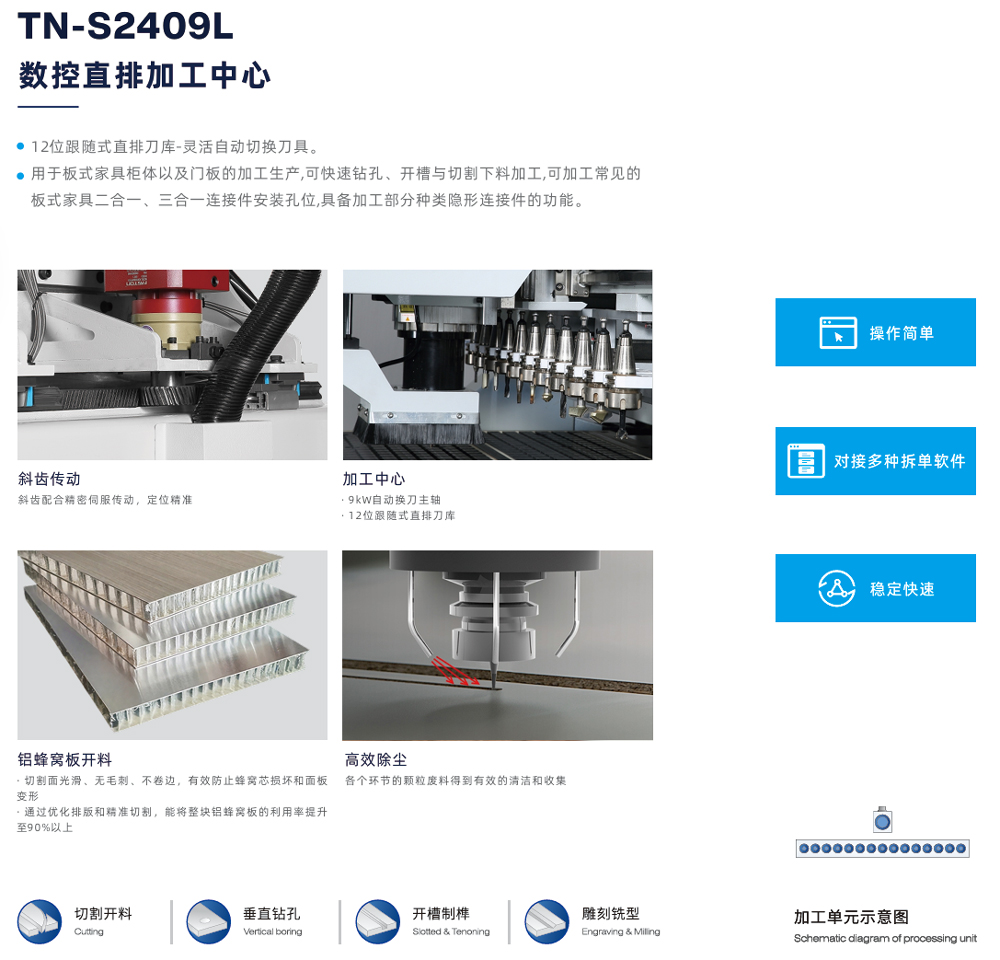
Cabinet panels may be manufactured from aluminum sheet, aluminum composite panel, aluminum honeycomb panel, or other composite structures.
Depending on the material, panel processing can include:
- Cutting
- Drilling
- Grooving
- Edge trimming
- Bending
- Routing
The machine should be selected according to panel thickness and surface requirements.
5. Cabinet Assembly Equipment
After machining, the components must be assembled.
Manual assembly can be suitable for customized products.
For higher production volumes, manufacturers can introduce automatic screw fastening, riveting, corner connector installation, and other assembly equipment.
6. Automatic Sorting
Modern cabinet factories may produce several orders simultaneously.
A sorting system can identify each component through barcode or QR-code information.
This prevents components from different cabinets from being mixed during production.
Technical Parameters for Cabinet Manufacturing Equipment
| Equipment | Main Parameter | Typical Configuration |
|---|---|---|
| Profile Cutting Machine | Cutting Length | Up to 6000 mm |
| Profile Cutting Machine | Cutting Accuracy | ±0.1 mm |
| CNC Drilling Machine | CNC Axes | 3–5 Axis |
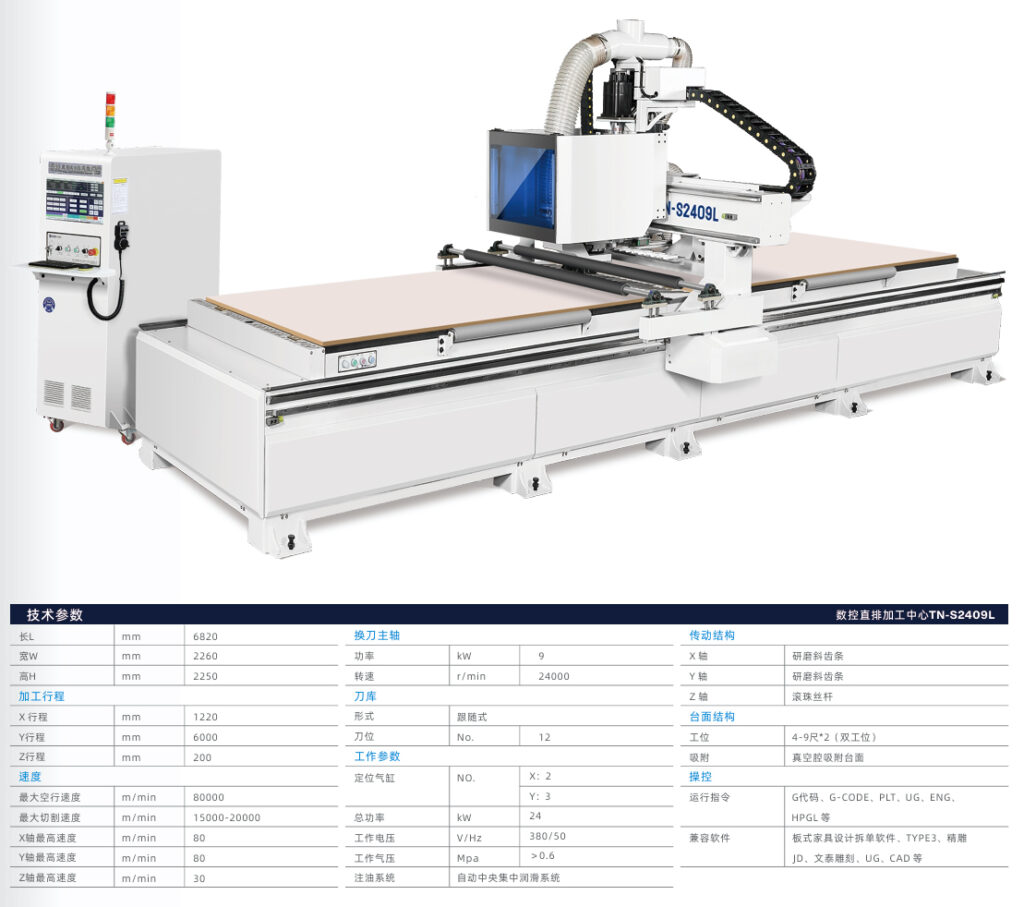
| CNC Machining Center | Spindle Power | 3–9 kW |
| CNC Machining Center | Spindle Speed | 6000–24000 rpm |
| Panel Cutting Machine | Panel Size | Customized |
| Panel Processing | Panel Thickness | Approximately 3–50 mm |
| Automatic Feeding | Feeding Method | Roller / Servo |
| Sorting System | Identification | Barcode / QR Code |
| Assembly System | Screw/Rivet | Optional Automatic |
| Control System | Interface | CNC / PLC / HMI |
These values are general reference ranges and should not be treated as specifications for every machine.
Production Line Configuration by Factory Size
Small Workshop
A small workshop may only require:
Cutting Machine + Drilling Machine + Assembly Tools
This configuration offers flexibility and lower initial investment.
Medium Factory
A medium-sized manufacturer may add:
Automatic Cutting + CNC Drilling + CNC Milling + Panel Processing + Assembly
This provides higher processing efficiency while maintaining flexibility.
Large Factory
A large factory may use:
Automatic Feeding + CNC Cutting + CNC Machining Center + Panel Processing + Sorting + Assembly + Inspection
Digital production management can also be integrated.
How to Choose Equipment
The first question should be: What type of aluminum cabinets will be produced?
Kitchen cabinets, bathroom cabinets, wardrobes, and commercial cabinets may use different profile structures.
The second question is production volume.
A factory producing a few dozen cabinets per day may not need a fully automated line.
The third consideration is customization.
If every customer requires different cabinet dimensions, CNC equipment becomes particularly valuable.
The fourth consideration is future expansion.
A modular production system allows additional CNC machines, automatic feeders, conveyors, or assembly systems to be added later.
Quality Control
Cabinet manufacturing requires dimensional control throughout production.
Profile length should be checked after cutting.
Hole positions should be verified after CNC drilling.
Groove dimensions should be inspected after milling.
Finished cabinet dimensions should be measured during final inspection.
Digital measurement equipment can be introduced for higher-volume manufacturing.
Conclusion
Aluminum Cabinet Manufacturing Equipment includes a complete range of machines covering profile cutting, drilling, milling, panel processing, sorting, and assembly.
The right configuration depends on cabinet design, production capacity, material specifications, customization requirements, and factory automation objectives.
For manufacturers planning an aluminum cabinet factory, equipment should be selected as an integrated production system rather than as unrelated individual machines.