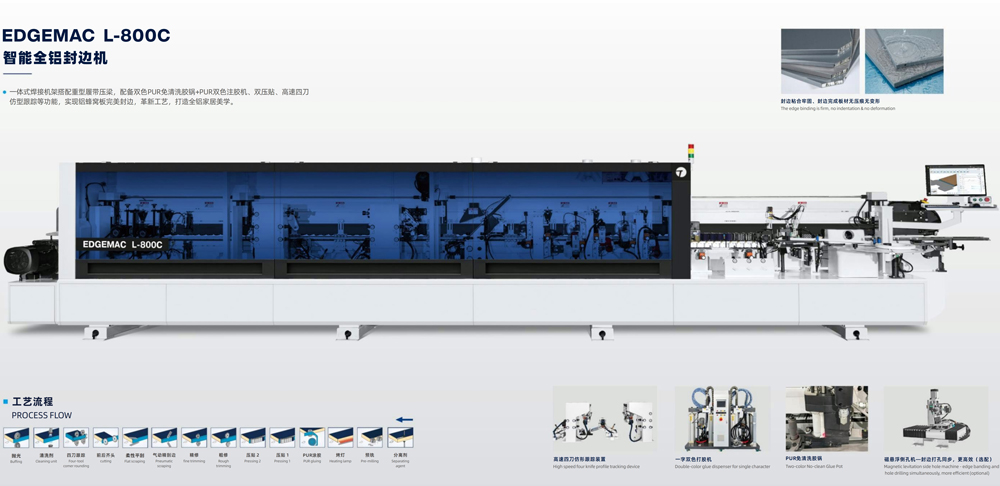
Furniture manufacturers are increasingly looking for ways to reduce repetitive labor while improving production consistency. For aluminum furniture manufacturers, an Automatic Aluminum Furniture Production Line can connect cutting, CNC machining, panel processing, sorting, and assembly into a coordinated workflow.
What Is an Automatic Aluminum Furniture Production Line?
An Automatic Aluminum Furniture Production Line is a manufacturing system in which multiple production processes are connected through automated equipment and control systems.
Depending on the factory configuration, automation may include:
- Automatic material feeding
- CNC profile cutting
- Automatic drilling
- CNC milling
- Panel cutting
- Component sorting
- Material transfer
- Assembly
- Quality inspection
The level of automation can be customized according to production requirements.
Typical Production Workflow
A typical automatic system can follow this process:
Raw Material → Automatic Feeding → Profile Cutting → CNC Drilling → CNC Milling → Panel Processing → Sorting → Assembly → Inspection
The actual sequence depends on furniture design.
Automatic Material Feeding
Automatic feeding systems can reduce manual material handling.
Profiles can be loaded and transferred to the cutting machine according to production orders.
Automatic feeding also helps maintain a consistent production rhythm.
CNC Processing
CNC equipment performs drilling, milling, slotting, and other machining operations.
Digital production data can determine the required processing parameters.
This supports customized production without requiring manual adjustment for every component.
Automatic Sorting
After machining, components must be matched with the correct furniture order.
Automatic sorting systems can use barcodes or production codes to identify components.
This is particularly useful when factories produce many different cabinet sizes simultaneously.
Assembly Automation
Assembly is often one of the more labor-intensive stages.
Depending on furniture design, automated screw fastening, riveting, connector installation, or robotic handling can be introduced.
However, not every factory requires fully robotic assembly. A hybrid system combining automated machining with manual assembly may be more practical for customized products.
Benefits of Automation
Higher Production Consistency
Automated processing can reduce variation caused by manual measurement and repetitive operations.
Improved Material Flow
Integrated material transfer reduces unnecessary movement between machines.
Flexible Production
CNC programming allows the same line to manufacture different furniture models.
Reduced Repetitive Labor
Automation can reduce repetitive cutting, drilling, and material-handling tasks.
Digital Production
Production data can be connected with ERP, MES, CAD, or other factory management systems.
Who Needs an Automatic Production Line?
An automatic line is particularly relevant to manufacturers with:
- High production volume
- Multiple daily orders
- Standardized furniture models
- Customized furniture with digital designs
- Large labor requirements
- Long-term factory automation plans
Smaller workshops may prefer a semi-automatic configuration.
Investment Considerations
Automation requires more investment than individual machines.
Buyers should therefore evaluate the expected production volume, labor costs, available factory space, product standardization, and expected return on equipment investment.
It is also important to consider machine maintenance, software upgrades, spare parts, and operator training.
Conclusion
An Automatic Aluminum Furniture Production Line can integrate multiple manufacturing processes into a coordinated system. By connecting automatic feeding, CNC machining, sorting, and assembly, manufacturers can improve production organization while supporting customized furniture production.
The best automation configuration depends on product type, output requirements, factory layout, and future expansion plans. A modular production line can allow manufacturers to increase automation gradually rather than replacing the entire production system at once.