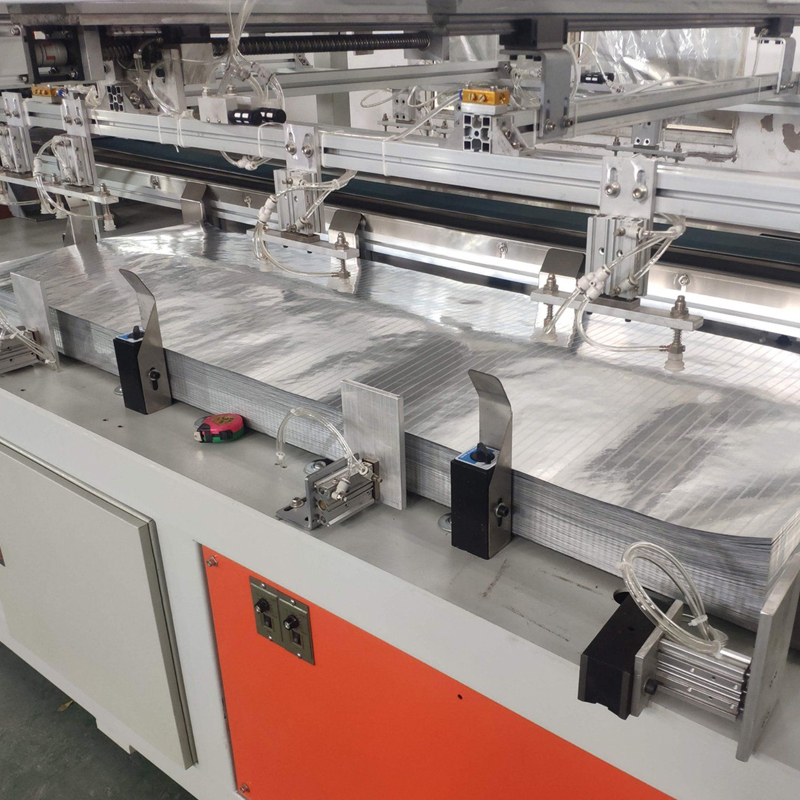
The demand for lightweight and high-performance composite panels is growing across Southeast Asia. Vietnam and Indonesia, in particular, have developed strong construction, transportation, marine, furniture, and industrial manufacturing sectors. This creates significant opportunities for local manufacturers of aluminum honeycomb panels.
For companies planning to establish or expand an aluminum honeycomb panel factory, an automatic aluminum honeycomb panel production line can provide a more efficient solution than relying on individual machines and manual production.
A properly designed production line can connect aluminum sheet preparation, adhesive application, honeycomb core assembly, pressing, curing, trimming, and inspection into a coordinated manufacturing process.
This guide explains how an automatic aluminum honeycomb panel production line works and what manufacturers in Vietnam and Indonesia should consider before investing in the equipment.
What Is an Automatic Aluminum Honeycomb Panel Production Line?
An automatic aluminum honeycomb panel production line is an integrated manufacturing system designed to produce aluminum honeycomb sandwich panels with reduced manual intervention.
The basic panel structure consists of two aluminum skins bonded to an aluminum honeycomb core.
The manufacturing process generally follows:
Aluminum Sheet → Cutting → Surface Preparation → Adhesive Application → Honeycomb Core Positioning → Panel Assembly → Pressing → Curing → Trimming → Inspection → Packaging
In a conventional workshop, many of these operations may be performed manually.
An automated production line connects several of these processes using dedicated machinery, conveyors, positioning systems, hydraulic equipment, control systems, and material handling equipment.
The objective is not simply to increase machine speed. The larger goal is to achieve stable production, consistent quality, lower labor dependency, and predictable manufacturing costs.
Why Vietnam and Indonesia Are Attractive Markets
Vietnam and Indonesia are two important manufacturing markets in Southeast Asia.
Both countries have large construction markets and growing demand for modern architectural materials. At the same time, transportation infrastructure, shipbuilding, commercial development, industrial facilities, and furniture manufacturing create additional opportunities.
Aluminum honeycomb panels are attractive because they combine:
- Lightweight construction
- High stiffness
- Good dimensional stability
- Large-format panel capability
- Flexible surface finishing
- Easy customization
- Efficient structural design
For local manufacturers, producing these panels domestically can also reduce dependence on imported finished products and provide greater control over delivery schedules and customization.
Main Sections of an Automatic Production Line
A complete automatic aluminum honeycomb panel production line can contain different equipment depending on the manufacturer’s requirements.
1. Automatic Aluminum Sheet Cutting
The first stage involves preparing the aluminum skins.
Automatic cutting equipment can process aluminum sheets according to programmed dimensions.
The system may be configured for different:
- Sheet lengths
- Sheet widths
- Aluminum thicknesses
- Panel dimensions
- Production batches
Accurate cutting is important because dimensional errors at the beginning of the production process can affect final panel assembly.
For high-volume production, automatic feeding and cutting can reduce material handling and improve production consistency.
2. Surface Preparation
Before bonding, the aluminum surface must be appropriately prepared.
The objective is to create a suitable bonding surface between the aluminum skin and adhesive.
Depending on the selected adhesive technology, surface preparation may involve cleaning, degreasing, sanding, chemical treatment, or another suitable process.
This stage should be designed together with the adhesive supplier and production equipment manufacturer.
3. Automatic Glue Application
The adhesive application system is one of the most important parts of the production line.
The machine should distribute adhesive consistently across the required bonding area.
Important parameters include:
| Parameter | Typical Consideration |
|---|---|
| Glue Application Width | Based on panel dimensions |
| Coating Quantity | Determined by adhesive system |
| Application Speed | Matched to production capacity |
| Coating Uniformity | Critical for bonding quality |
| Adhesive Type | Epoxy, polyurethane or other systems |
| Curing Method | Temperature and time dependent |
The exact adhesive quantity should always be determined through process testing rather than using a universal value.
Automatic glue application can reduce variations caused by manual operation.
It can also help manufacturers control adhesive consumption, which is important because adhesive is a significant consumable cost in composite panel production.
4. Honeycomb Core Positioning
After adhesive application, the aluminum honeycomb core needs to be positioned accurately.
The core can be supplied in different specifications according to the final application.
Typical variables include:
- Core thickness
- Cell size
- Aluminum foil thickness
- Core density
- Aluminum alloy
For example, a thicker core can provide greater panel thickness and stiffness, while a smaller cell size can offer different structural characteristics.
The production line should be capable of handling the core specifications required by the manufacturer’s target products.
5. Automatic Panel Assembly
The aluminum skins and honeycomb core are assembled into a sandwich structure.
At this stage, alignment is critical.
The production equipment should maintain accurate positioning between the top aluminum sheet, core, and bottom aluminum sheet.
For large-format panels, automatic positioning systems can help reduce alignment errors.
This becomes particularly important when producing architectural panels with strict dimensional requirements.
6. Hydraulic Pressing System
Once the panel has been assembled, it enters the pressing stage.
The pressing system applies controlled pressure to the panel structure.
A modern hydraulic press should provide stable pressure across the working area.
For large panels, uniform pressure distribution is particularly important because localized pressure differences may contribute to inconsistent bonding or surface defects.
The pressing system can be configured according to:
- Maximum panel dimensions
- Panel thickness
- Required pressure
- Adhesive technology
- Production capacity
- Curing method
7. Heating and Curing
Some adhesive systems require controlled temperature curing.
A heating system can be integrated into the production process to provide the required curing conditions.
The curing process depends heavily on the adhesive formulation.
Important variables may include:
- Curing temperature
- Curing time
- Heating uniformity
- Panel thickness
- Ambient temperature
Manufacturers should therefore avoid selecting heating equipment based only on maximum temperature. Temperature uniformity and process stability are equally important.
8. Automatic Trimming and CNC Processing
After curing, the finished panel may require edge trimming.
Automatic trimming equipment can produce consistent panel dimensions and clean edges.
For customized architectural and transportation panels, CNC processing can also be added.
CNC equipment can perform:
- Straight cutting
- Curved cutting
- Openings
- Holes
- Slots
- Special shapes
- Edge machining
This gives manufacturers greater flexibility when supplying customized projects.
Typical Production Line Configuration
A medium-scale factory may configure its equipment around the following workflow:
| Production Section | Main Equipment | Main Purpose |
|---|---|---|
| Raw Material | Sheet Handling System | Aluminum sheet movement |
| Cutting | Automatic Cutting Machine | Panel size preparation |
| Surface Preparation | Cleaning/Treatment System | Improve bonding |
| Adhesive | Automatic Glue Coater | Uniform adhesive application |
| Core | Honeycomb Core Cutting Equipment | Core preparation |
| Assembly | Positioning Table/System | Panel alignment |
| Pressing | Hydraulic Press | Bonding pressure |
| Curing | Heating/Curing System | Adhesive curing |
| Finishing | Trimming Machine | Final dimensions |
| CNC | CNC Router/Cutting Machine | Customized processing |
| Inspection | QC Equipment | Quality control |
| Packaging | Packing System | Finished product protection |
The actual configuration should be customized according to production volume and product specifications.
Production Capacity and Factory Planning
One of the most important questions for Vietnamese and Indonesian investors is production capacity.
Instead of asking only for the maximum machine speed, manufacturers should calculate their expected annual output.
For example, if a factory targets 100,000 m² of panels per year and operates approximately 250 production days, the average daily requirement is:
100,000 ÷ 250 = 400 m² per day
However, actual production planning should include downtime, maintenance, product changeover, curing time, operator efficiency, and rejected products.
Therefore, the machine’s theoretical maximum capacity should not automatically be treated as its real-world production output.
Automation Level Comparison
Manufacturers can choose different levels of automation.
| Feature | Manual | Semi-Automatic | Fully Automatic |
|---|---|---|---|
| Labor Requirement | High | Medium | Lower |
| Initial Investment | Low | Medium | Higher |
| Production Consistency | Operator dependent | Good | High |
| Customization | Flexible | Flexible | Depends on system |
| Production Volume | Small | Medium | Medium to High |
| Material Handling | Manual | Partly automated | Automated |
| Process Control | Basic | Improved | Advanced |
| Suitable Factory | Small workshop | Growing manufacturer | Industrial factory |
For a new factory, semi-automatic equipment may offer a reasonable balance between investment and flexibility.
For manufacturers with stable high-volume orders, a fully automatic line may provide better long-term productivity.
Benefits of Automatic Manufacturing Equipment
Reduced Manual Labor
Automation can reduce repetitive material handling and production operations.
This can be particularly valuable as labor costs and workforce availability become increasingly important factors in Southeast Asian manufacturing.
Better Production Consistency
Automated cutting, adhesive application, positioning, and pressing can reduce variation between panels.
Consistent manufacturing is especially important for large construction projects where hundreds or thousands of panels may need to meet the same specifications.
Better Material Utilization
Accurate cutting and controlled adhesive application can help reduce material waste.
This can lower production costs while improving overall manufacturing efficiency.
Higher Production Efficiency
An integrated production line reduces unnecessary movement between individual machines.
Instead of transferring materials manually between separate workstations, the production process can be organized into a continuous workflow.
Easier Production Expansion
An appropriately designed production line can also provide a foundation for future expansion.
Additional CNC equipment, automated handling systems, larger presses, or additional production sections can potentially be integrated as production demand increases.
What Should Vietnamese and Indonesian Buyers Ask Suppliers?
Before purchasing an automatic aluminum honeycomb panel production line, buyers should provide detailed technical information.
Important questions include:
- What is the maximum panel size?
- What panel thickness range can the machine produce?
- What aluminum skin thickness can be processed?
- What honeycomb core specifications are supported?
- What adhesive systems are compatible?
- What is the expected production capacity?
- How many operators are required?
- What is the installed electrical power?
- What maintenance is required?
- Is installation support available?
- Is operator training included?
- What spare parts are recommended?
The more complete the technical information provided to the supplier, the more accurate the production line proposal will be.
Consider Local Factory Conditions
Equipment designed for Vietnam or Indonesia should also take local factory conditions into consideration.
Electrical specifications, factory layout, environmental conditions, material storage, ventilation, compressed air availability, and maintenance capabilities can all affect production.
For example, adhesive storage and curing conditions may require controlled environmental conditions depending on the adhesive technology.
A production line should therefore be designed around the actual factory rather than simply purchased as a standard package.
Cost and Return on Investment
The investment cost of an automatic aluminum honeycomb panel production line depends on the configuration.
Major factors include:
- Production capacity
- Automation level
- Press size
- Cutting equipment
- Glue application system
- Curing technology
- CNC equipment
- Material handling
- Electrical control system
- Installation and commissioning
Instead of comparing quotations based only on the lowest purchase price, manufacturers should evaluate the expected return on investment.
A useful calculation should consider:
Production Output + Selling Price − Raw Material Cost − Labor Cost − Energy Cost − Maintenance Cost = Operating Profit
This gives investors a clearer understanding of the actual economics of the production line.
Conclusion
An automatic aluminum honeycomb panel production line for Vietnam and Indonesia can provide manufacturers with a scalable solution for producing architectural, transportation, marine, furniture, and industrial panels.
The key is not simply purchasing the most automated machine available. The production line should be matched with the factory’s actual market, product dimensions, annual production target, labor conditions, adhesive technology, and future expansion plans.
For Southeast Asian manufacturers, a well-designed automated system can improve production consistency, reduce manual operations, optimize material usage, and support customized panel manufacturing.
As Vietnam, Indonesia, and neighboring markets continue to develop their construction and manufacturing industries, modern aluminum honeycomb panel production equipment can help local manufacturers move from small-scale manual production toward more efficient and standardized industrial manufacturing.