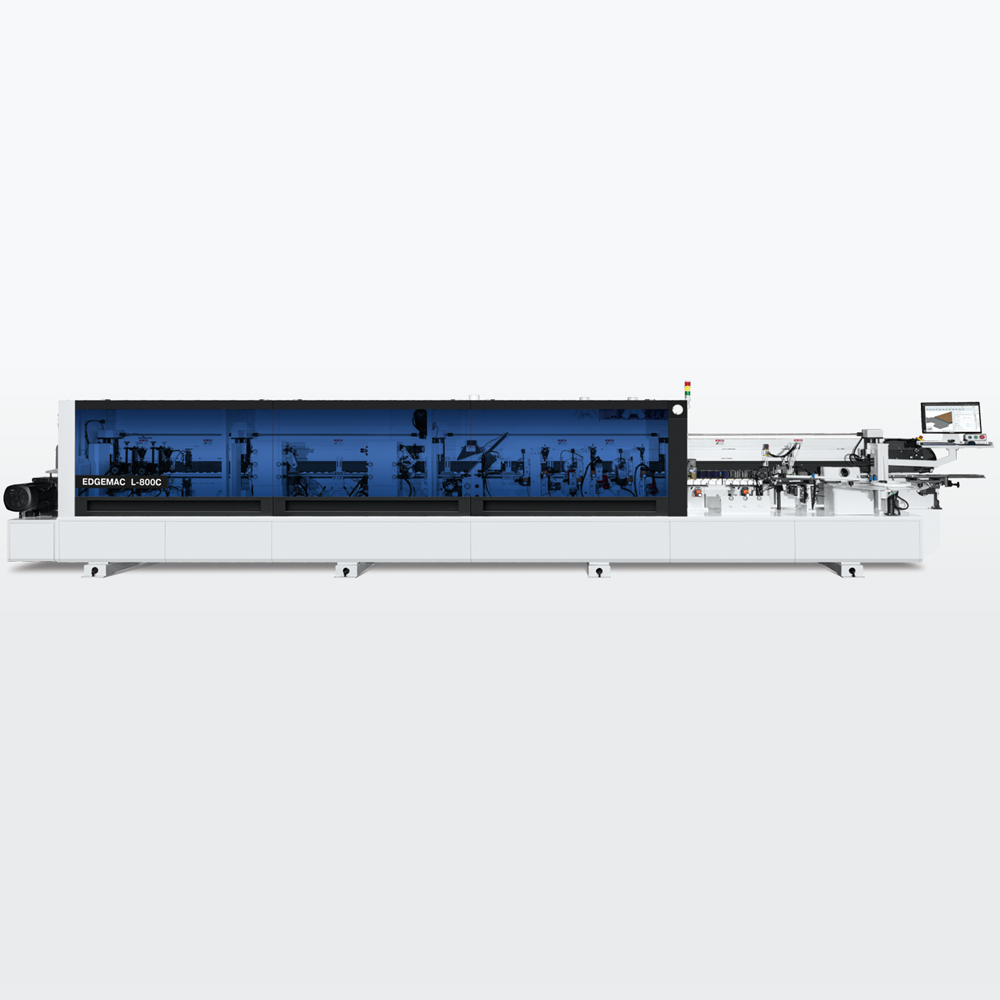
1. Introduction: Understanding EVA and PUR Edge Banding Technology
Adhesive technology is one of the most important factors affecting the performance of an Edge Banding Machine. The adhesive determines how effectively the edge banding material bonds to the panel, how resistant the finished edge is to moisture and heat, and how well the product performs during long-term use.
Two of the most widely used adhesive technologies in industrial edge banding are EVA (Ethylene Vinyl Acetate) hot melt adhesive and PUR (Polyurethane Reactive) adhesive.
An EVA Edge Banding Machine uses thermoplastic hot melt adhesive to create a physical bond between the panel and the edge material. A PUR Edge Banding Machine uses reactive polyurethane adhesive that forms additional chemical cross-links during curing.
Although both technologies are used in furniture and panel manufacturing, they differ in bonding mechanisms, equipment requirements, processing conditions, and final product performance.
Understanding these differences helps manufacturers select the appropriate edge banding equipment for MDF, plywood, particleboard, aluminum panels, and specialized composite materials.
2. What Is an EVA Edge Banding Machine?
An EVA Edge Banding Machine uses Ethylene Vinyl Acetate hot melt adhesive to bond edge materials to panel edges.
EVA adhesive is a thermoplastic material. It becomes molten when heated and solidifies when cooled, creating a physical bonding connection between the panel and the edge banding strip.
Working Principle
The EVA hot melt edge banding process typically includes the following operations:
- Adhesive heating: EVA adhesive granules are heated in a glue pot until they reach the required application temperature.
- Adhesive application: A glue roller or application unit distributes molten adhesive onto the panel edge or edge banding material.
- Edge material feeding: PVC, ABS, veneer, or another compatible edge material is positioned against the panel.
- Pressing: Pressure rollers ensure sufficient contact between the edge material and the adhesive.
- Cooling: The adhesive cools and solidifies, establishing the initial bond.
- Trimming and finishing: Excess edge material is removed, followed by scraping and polishing.
Advantages of EVA Edge Banding
- Relatively low equipment investment
- Simple adhesive handling and operation
- Fast initial bonding through cooling
- Wide compatibility with conventional furniture edge materials
- Straightforward maintenance and cleaning
- Suitable for high-volume standard furniture production
Limitations
EVA adhesive is generally more sensitive to prolonged moisture exposure and elevated temperatures than properly cured PUR adhesive systems.
Its thermoplastic characteristics mean that bonding performance can decrease when the adhesive is exposed to temperatures near or above its softening range.
For applications requiring enhanced moisture resistance and thermal stability, PUR technology may provide a better solution.
3. What Is a PUR Edge Banding Machine?
A PUR Edge Banding Machine uses reactive polyurethane hot melt adhesive to bond edge materials to panels.
Unlike conventional EVA adhesive, PUR adhesive does not rely solely on cooling to establish its final bonding structure. After application, it reacts with moisture and forms a cross-linked polymer network during curing.
This chemical reaction improves the durability of the adhesive bond and generally provides better resistance to water, heat, and certain chemicals.
Working Principle
The PUR edge banding process involves several stages:
- Adhesive preparation: PUR adhesive is supplied in a suitable sealed container or cartridge to minimize unwanted moisture exposure.
- Controlled heating: The adhesive is heated to its specified processing temperature.
- Adhesive application: A controlled application system distributes the reactive adhesive along the panel edge.
- Edge bonding: The edge banding material is positioned and pressed against the adhesive-coated surface.
- Initial fixation: The adhesive develops an initial bond that holds the edge material in position.
- Chemical curing: Moisture triggers the polyurethane reaction, gradually forming a cross-linked structure.
- Final performance development: The adhesive reaches its specified final bonding properties after the required curing period.
The actual curing time depends on adhesive formulation, ambient humidity, temperature, substrate properties, and application thickness.
Advantages of PUR Edge Banding
- Improved moisture resistance
- Better heat resistance than many conventional EVA systems
- Strong bonding performance
- Suitable for demanding furniture applications
- Reduced risk of visible glue lines when correctly applied
- Good compatibility with many modern decorative edge materials
Limitations
PUR edge banding systems generally require higher equipment investment and more careful process management.
Because PUR adhesive reacts with moisture, the adhesive supply system, application unit, and storage conditions must be properly controlled.
Uncured adhesive residue can also be difficult to remove after moisture exposure. Equipment cleaning and maintenance procedures are therefore especially important.
4. EVA vs PUR Edge Banding: Technical Comparison
The following table summarizes the major differences between EVA and PUR adhesive technologies.
| Comparison Item | EVA Hot Melt Adhesive | PUR Reactive Adhesive |
|---|---|---|
| Full Name | Ethylene Vinyl Acetate | Polyurethane Reactive |
| Bonding Mechanism | Physical cooling and solidification | Cooling followed by moisture-triggered chemical curing |
| Initial Bonding | Generally fast | Develops through cooling and initial fixation |
| Final Bond Development | Mainly through solidification | Continues through chemical curing |
| Moisture Resistance | Moderate, formulation-dependent | Generally higher after proper curing |
| Heat Resistance | Limited by thermoplastic behavior | Generally improved after curing |
| Chemical Resistance | Formulation-dependent | Often improved after cross-linking |
| Equipment Cost | Generally lower | Generally higher |
| Maintenance | Relatively simple | Requires careful moisture control |
| Adhesive Cleaning | Generally easier before hardening | More demanding after curing |
| Typical Applications | Standard furniture and cabinets | Premium furniture and demanding environments |
Actual performance depends on adhesive formulation, substrate preparation, edge material, application conditions, and testing methods. PUR should not automatically be considered suitable for every substrate without compatibility testing.
5. Important Processing Parameters for EVA and PUR Edge Banding
Proper parameter control is essential for achieving consistent edge bonding quality.
EVA Processing Parameters
Typical EVA hot melt adhesive application temperatures are approximately 180–220°C, depending on the adhesive formulation and machine design.
| Parameter | Typical Reference Range |
|---|---|
| Application Temperature | 180–220°C |
| Adhesive Type | EVA Hot Melt |
| Application Method | Roller or nozzle |
| Bonding Method | Pressure bonding |
| Initial Bond Formation | Cooling and solidification |
| Common Edge Materials | PVC, ABS, veneer |
| Typical Substrates | MDF, particleboard, plywood |
PUR Processing Parameters
PUR hot melt adhesives often operate at approximately 100–140°C, although the recommended temperature varies considerably by formulation.
| Parameter | Typical Reference Range |
|---|---|
| Application Temperature | 100–140°C |
| Adhesive Type | Reactive Polyurethane |
| Application Method | Controlled roller or nozzle |
| Bonding Method | Pressure bonding |
| Final Bond Development | Moisture-triggered curing |
| Common Edge Materials | PVC, ABS, veneer and compatible materials |
| Typical Substrates | MDF, plywood, selected composite panels |
These are indicative processing ranges, not universal machine settings. Manufacturers must follow the adhesive supplier’s technical data sheet and equipment manufacturer’s operating instructions.
For both technologies, excessive adhesive temperature can cause degradation, while insufficient temperature may result in poor flow, uneven coating, and inadequate bonding.
6. Which Edge Banding Technology Is Better for Different Applications?
The choice between EVA and PUR depends on the operating environment, panel material, production requirements, and expected service life.
Kitchen Cabinet Manufacturing
Kitchen cabinets are frequently exposed to steam, water splashes, temperature changes, and cleaning chemicals.
PUR edge banding is often preferred for premium kitchen cabinets because of its improved moisture resistance after curing.
EVA remains a practical solution for standard furniture products where environmental exposure is relatively controlled.
Bathroom Cabinet Manufacturing
Bathroom furniture operates in a high-humidity environment. Edge bonding quality is particularly important because moisture penetration may cause panel swelling or deterioration.
PUR edge banding is generally a suitable choice when the substrate and edge materials are compatible with the adhesive.
Office Furniture and Wardrobes
For office desks, wardrobes, shelving systems, and standard indoor furniture, EVA edge banding often provides a cost-effective manufacturing solution.
PUR may be selected for higher-end products requiring improved durability and reduced visible glue lines.
Aluminum Honeycomb Panel Manufacturing
Aluminum honeycomb panels consist of metal face sheets, an aluminum honeycomb core, and structural adhesive layers.
Their edge treatment is different from conventional MDF furniture panels.
Depending on panel construction, manufacturers may use aluminum edge strips, folded metal edges, adhesive bonding, or mechanical fastening.
PUR adhesive may be considered for certain aluminum edge bonding applications, but the surface treatment, primer requirements, adhesive formulation, and compatibility with the metal substrate must be evaluated.
FRP and Foam Core Composite Panels
FRP sandwich panels and foam core composite panels require adhesives compatible with fiberglass surfaces and the selected core materials.
PVC foam, PET foam, XPS foam, and polyurethane foam have different surface characteristics and chemical compatibility requirements.
A specialized Composite Panel Edge Sealing Machine may be more appropriate than a conventional PUR woodworking edge bander for these applications.
7. How to Choose Between an EVA and PUR Edge Banding Machine
Industrial buyers should consider the following factors before purchasing equipment.
Production Volume
EVA systems are often suitable for manufacturers seeking economical and straightforward high-volume production.
PUR systems are attractive for manufacturers producing higher-value products with more demanding bonding requirements.
Product Environment
Products exposed to humidity, water splashes, or temperature changes may benefit from PUR adhesive technology, provided the entire panel construction is adequately protected.
Equipment Configuration
An EVA edge banding machine and a PUR edge banding machine may share similar mechanical processing units, but their adhesive storage, heating, application, and cleaning systems differ.
PUR equipment may require sealed adhesive containers, moisture-controlled application systems, and specialized cleaning procedures.
Material Compatibility
The adhesive must be compatible with both the panel substrate and the edge banding material.
For aluminum, FRP, PVC foam, and other composite materials, manufacturers should perform bonding tests before finalizing the equipment configuration.
Total Manufacturing Cost
The purchase price is only one part of equipment investment.
Manufacturers should also consider adhesive consumption, production speed, maintenance costs, cleaning requirements, labor, material waste, and finished product quality.
8. Conclusion
EVA and PUR are two important adhesive technologies used in modern edge banding machines.
EVA hot melt adhesive offers simple processing, lower equipment investment, and good suitability for conventional furniture manufacturing. PUR reactive adhesive provides enhanced moisture and heat resistance after proper curing, making it attractive for demanding furniture and industrial applications.
For manufacturers producing MDF cabinets, wardrobes, and standard furniture panels, EVA technology remains a practical and economical option.
For premium furniture, moisture-exposed products, and selected composite panel applications, PUR edge banding may provide additional performance advantages.
However, the most suitable solution should always be determined by adhesive compatibility, panel structure, processing conditions, and actual performance testing.
Selecting the right Edge Banding Machine and adhesive technology helps manufacturers achieve reliable bonding, consistent edge quality, and improved long-term product performance.